

Pessimism about the economic future of Europe is rampant. Since the publication of the Draghi Report (2024), dire warnings about Europe’s future have surged. Not a day passes without some very serious economist declaring that Europe risks becoming a second-rate economy, overpowered by the US and China. Comparisons of Europe with the US abound and Europe is almost always seen as losing the economic battle with the US: Europe’s productivity growth lags behind the US; its competitiveness declines dangerously; its industry is disappearing; hi-tec companies relocate to the US; the European social model is becoming unsustainable. All this leads to panic reactions in the policy area. The European policymakers propose an unending list of initiatives to deal with the existential crises faced by Europe.
While many economists and policymakers double down on pessimism the stock markets in Europe seem to be quite relaxed about the existence of an economic crisis in Europe. Figure 1 shows the indices of American and European stock prices since January 1, 2025. This is the date just after the publication of the Draghi Report and just before the start of the Trump administration. Stock prices are forward looking variables. They express the beliefs investors have about the future profits of companies.
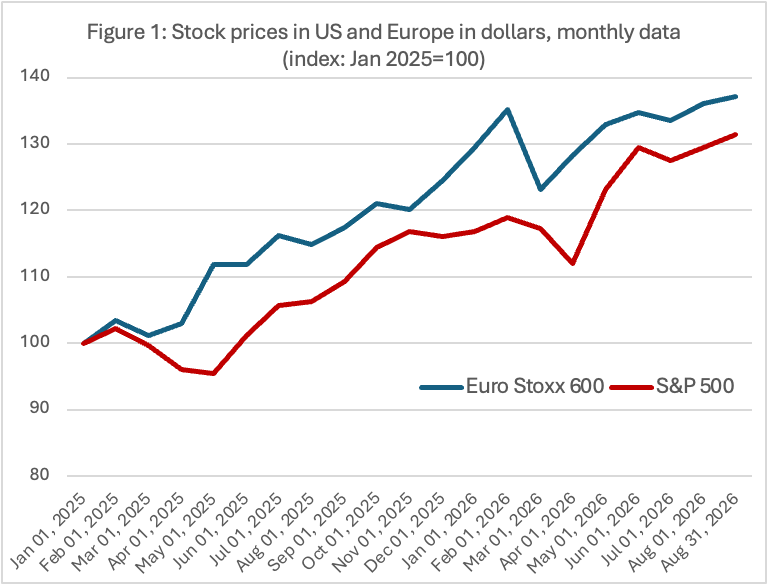
Source: Federal Reserve of St Louis, FRED and Investing.com
The indices are expressed in a common currency, the dollar. That is, we ask the question of what the beliefs are of international investors managing a worldwide dollar portfolio about the future profitability of the European firms as compared to American ones. Here is the result (Figure 1): The cumulative return (in dollars) of European stocks was 37% versus 31% for US stocks. Thus, it appears that since 2025 these international investors have changed their views and have become more optimistic about the future profitability of European firms as compared to American firms. This is in striking contrast with the increasing pessimism emanating from many economists and policymakers.
It should be noted that the outperformance of the European stock price index has much to do with the appreciation of the euro against the dollar since the start of 2025. This appreciation amounted to 16%. This, however, does not undermine the general conclusion that since 2025 investors have become more optimistic about Europe. The exchange rate is also a forward-looking variable expressing beliefs about future relative macroeconomic performances of countries. Investors seem to believe that these future macroeconomic performances in Europe have improved when compared to the US since 2025.
This leads to the question of why two groups of people, economists and policymakers on the one hand and investors on the other hand, have such strongly diverging views about the economic future of Europe. Why is there so much pessimism among the former and so much optimism among the latter?
One possible answer is that economists and policymakers are better informed than investors about the intricacies of the workings of the economy and thus about the risks that the economy will face in the future. Their current pessimism then just reflects superior knowledge. But that does not seem to be a good answer. The information on which economists base their pessimistic analyses are readily available and are known also by investors. These, however, do not seem to be impressed on the contrary.
Another answer is that investors are often irrational, being gripped by excessive optimism, which after some time leads to a crash and an abrupt reversal of beliefs. I have sympathy with this view. There are many historical episodes of bubbles in the stock markets, i.e. periods of euphoria alternating with depression. We may be experiencing today one such episode of excessive optimism that after some time will lead to a dramatic reversal in beliefs.
But wait, this does not seem to be right interpretation of what we observe in stock markets. If anything, the euphoria of investors seems to be present mainly in America. The stories we hear from AI-titans is that the new disruptive AI-technologies will lead to infinite profit opportunities in the future. The wonders are in America. This belief has attracted massive amounts of capital to be invested in new AI-technologies, including data centres. If there is “irrational exuberance” today this seems to be more the case in the US than in Europe. Yet it is the European stocks that have been increasing faster than the American ones when expressed in the same currency.
What about a third possible explanation? Economists and policymakers, like investors, can also be influenced by sentiments of optimism and pessimism. The pessimism of economists and policymakers observed today may be the result not so much of rational analysis but of pessimistic sentiments that colours their analysis.
How can such a pessimism arise? There are usually some objective reasons why pessimism emerges. Today such a reason is the fact that Europe is lagging in new hi-tech industries, in particular in Artificial Intelligence. This is an undisputable fact. But this fact has been amplified by the belief that AI will create incredible economic wonders. The AI-titans have done everything to make us believe that this is the most important technological development in human history. They did this mostly to attract massive amounts of capital.
While there is no doubt that AI is very important and provides the tools for increasing productivity, the claims that have been made by the AI-titans that artificial intelligence will soon surpass human intelligence in all conceivable domains are excessive. It is just not credible that a technology that bases its knowledge exclusively on texts and pictures found on internet will surpass general human intelligence which is based not only on these sources but also on observation of the living world and on interactions with other people.
The claims that AI will create superintelligence dwarfing human intelligence, however, are now believed by many, including many economists and policymakers. The fact that Europe lags in the development of AI is then seen as an existential threat for Europe and helps to explain the pessimism about Europe.
When people are pessimistic, they tend to disregard optimistic signals. Psychologists have a name for this: cognitive dissonance. This is happening today. Economists and policymakers, influenced by dire predictions of future doom, fail to take into account the areas in which Europe is not lagging behind the US. Examples abound: the energy transition, new green technologies, bio-sciences, pharmaceuticals, health care. Some of these are equally important as AI as they will affect the future of the planet. In energy transition and green technologies Europe even leads the US. Cognitive dissonance, however, ensures that they are not on the radar screen of the pessimists.
This being said Europe faces serious problems, but they are not more serious than the American ones. Trump’s destruction of American democracy and his attempts to destroy green technologies and energy transition will create problems in the US that are equally, if not more, intense than the problems in Europe. There is no reason to be more pessimistic about Europe than about America.
The European economic problems are real and will require new policies to stimulate economic growth and to boost technological innovations that have an imprint in Europe. This will necessitate more public investment, reinforcement of the internal market and a capital markets union. Not much more is necessary.
Actually credible economists do not peddle this Europe Doom stories at all. Paul Krugman for example goes out of his way to dispel this unwarranted doom and gloom, and confronts US's triumphalism instead.
Lots of companies in Euro Stoxx or S&P 500 are worldwide companies.
As a result, saying Euro Stoxx or S&P performance is a result of the performance of respective national economies is mostly untrue.